Bessent Warns: U.S. Cannot Lose AI Race to China
09/12/2026 / By Chase Codewell
Treasury Secretary Scott Bessent said the U.S. cannot afford to fall behind China in artificial intelligence (AI) – warning on Wednesday, Sept. 9, that a Chinese lead would outweigh other American advantages.
His remarks came during a question about opposition to data centers and the buildout of infrastructure required for AI development. “Beating China – there is no day after tomorrow if China wins at this,” Bessent said at Breitbart News‘ “State of the Economy” event in Washington, according to the Epoch Times. “If they were to pull ahead of us on AI, then nothing else matters.”
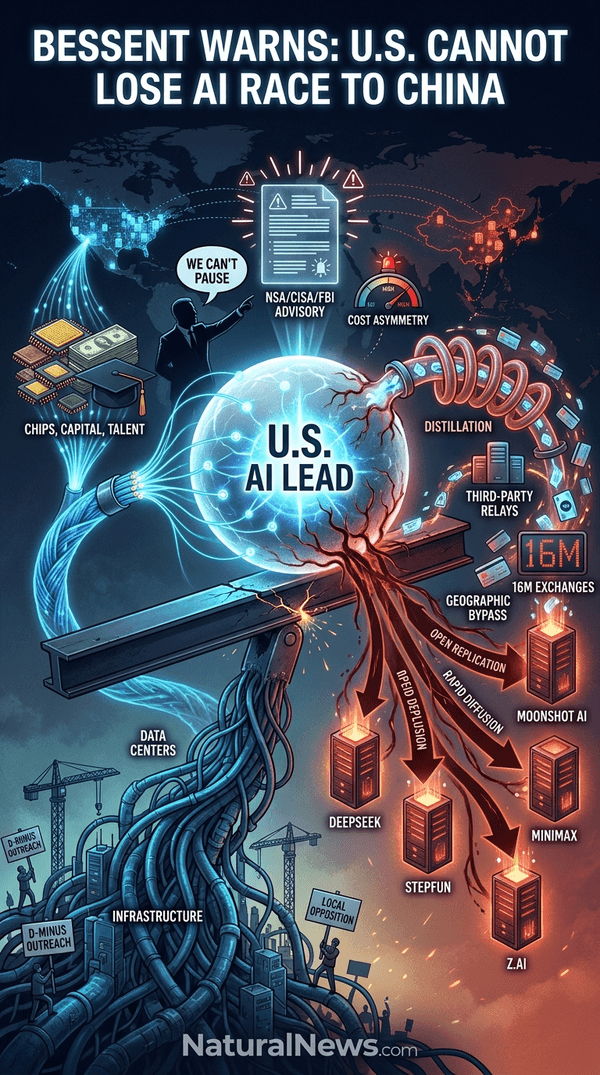
On the same day, the National Security Agency, the Cybersecurity and Infrastructure Security Agency and the Federal Bureau of Investigation issued a joint advisory accusing six China-based AI companies of conducting industrial-scale campaigns to extract capabilities from U.S. frontier AI models [1]. The agencies named DeepSeek, Moonshot AI, Alibaba, MiniMax, StepFun and Z.AI, saying the companies had extracted billions of tokens through millions of requests to frontier models including Claude, GPT, Gemini and Grok since at least late 2024 [1].
Federal Advisory Names Six Chinese AI Firms
The advisory alleged that the six companies engaged in “aggressive, malicious and targeted” distillation at an industrial scale to extract restricted proprietary functions and capabilities from U.S. models. According to the advisory, the companies distributed their activity across model providers, cloud platforms and other infrastructure to avoid detection. Some used third-party services to relay requests to U.S. models, allowing them to bypass geographic restrictions and other safeguards, the agencies said [1].
Knowledge distillation is a machine learning technique in which one model is trained using the outputs of another. The technique is commonly used legitimately, including to develop smaller or less expensive models. The agencies assessed that the alleged activity took place “likely with Chinese government awareness,” though the advisory did not state that Chinese authorities directed the individual campaigns [2].
The advisory said DeepSeek had allegedly conducted an organized campaign since at least late 2024 to obtain reasoning capabilities, specialized optimizations and other functions for use in its R1 and V3 models. The agencies also attributed large-scale distillation activity to Alibaba’s Qwen models and to models developed by the other four companies [1].
Beijing rejected the allegations on Sept. 9. Chinese Ministry of Foreign Affairs spokeswoman Mao Ning said China’s AI development came from domestic technological development and international cooperation [1].
U.S. AI Developers Had Raised Earlier Alarms
The federal advisory follows earlier accusations by American AI developers. Anthropic said in February that it had identified industrial-scale campaigns by DeepSeek, Moonshot AI and MiniMax involving more than 16 million exchanges with Claude through approximately 24,000 fraudulent accounts [1].
The accounts violated its terms of service and regional access restrictions, Anthropic said. It also said that while distillation is a legitimate training method, competitors can misuse it to acquire capabilities developed by other companies without bearing comparable development costs.
OpenAI separately told the House Select Committee on the Chinese Communist Party in February that it had observed activity indicating continued attempts by DeepSeek to distill capabilities from OpenAI and other U.S. frontier models, including through increasingly obfuscated methods intended to make the activity harder to detect [1].
The dispute over model distillation has unfolded alongside a broader pattern of Chinese technical replication. In December 2024, researchers from Fudan University and the Shanghai AI Laboratory successfully replicated OpenAI’s advanced o1 reasoning model, a key step toward replicating frontier AI capabilities [3]. The release of DeepSeek’s open-source reasoning model sent shockwaves through the tech industry, with the model rivaling OpenAI’s systems at a fraction of the cost and running on standard hardware [4].
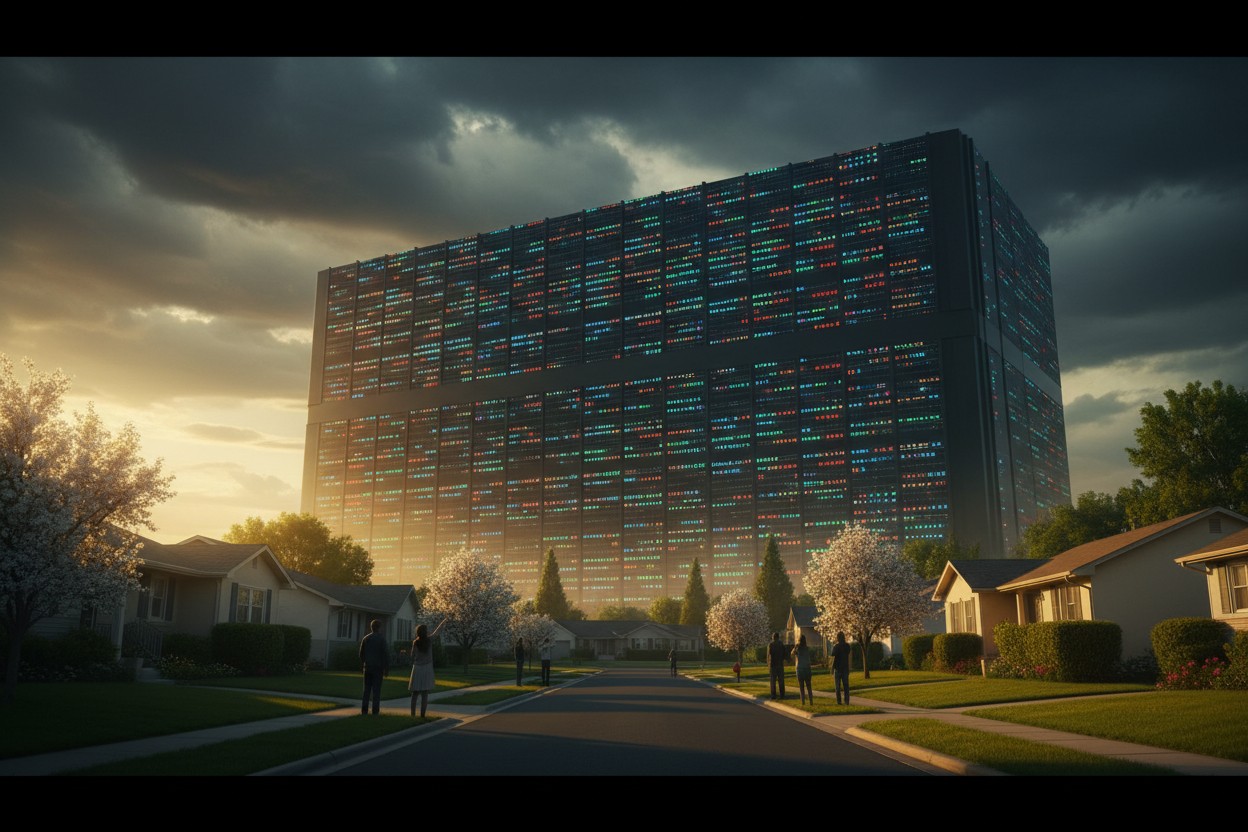
Bessent Ties AI Race to Data Centers, Gives Industry D-Minus
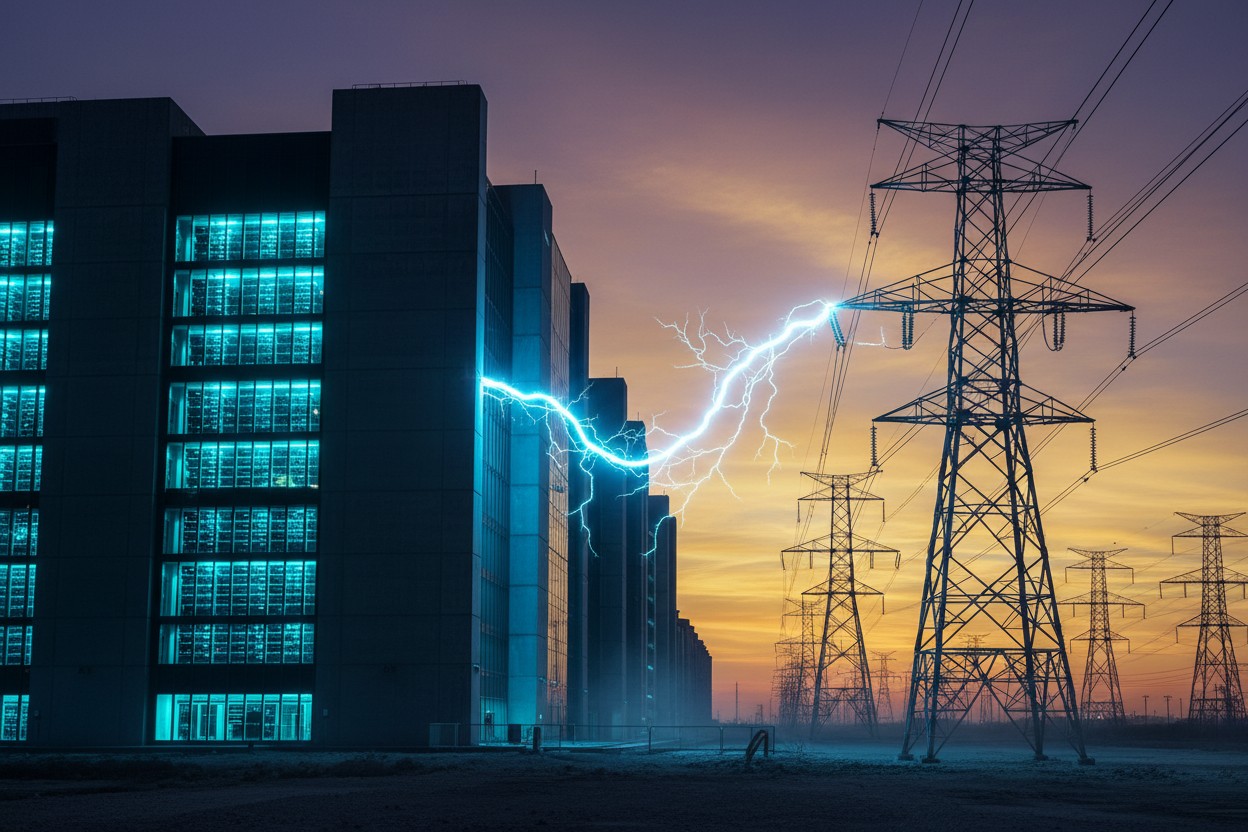
Bessent tied the competition with China to the U.S. buildout of data centers and other infrastructure needed for AI. He said the United States currently has the lead because of its technology companies, advanced chips, financing and startup ecosystem, but argued that development could not be paused.
“We can’t pause,” Bessent said. “You can’t, because the Chinese won’t pause” [1].
He criticized technology companies for failing to engage adequately with communities affected by new data-center construction. Bessent also alleged that some opposition to data-center development involved Chinese “agitprop.” He did not identify specific examples for that assertion during the discussion [1].
The treasury secretary gave data-center developers, hyperscalers and major AI companies a “D-minus” for community outreach and said they needed to do a better job explaining their projects and potential benefits to residents, according to the report. The distinction between U.S. and Chinese approaches has also been documented by industry observers.
Hugging Face CEO Clement Delangue said in August that Chinese developers were clearly dominating in open models. He attributed China’s position to an open collaboration and sharing ecosystem, while U.S. model makers were “building in silos” and risked falling behind [5].
Conclusion: Advisory Urges Detection as Competition Continues
The Sept. 9 advisory urged American AI companies and infrastructure providers to improve detection of suspicious activity and strengthen coordination across model developers, cloud providers and API providers to counter large-scale distillation campaigns [1]. The agencies said that such distillation could allow Chinese AI developers to narrow the technology gap while avoiding some of the computing power, electricity, foundational research and other costs required to independently develop frontier models [2].
The advisory stated that advances in Chinese AI models could also expand military and cyber capabilities. No resolution to the dispute was reported [1]. Some analysts have noted that the concentrated structure of the U.S. AI industry, where a handful of large corporations hold most resources, may affect how the competitive landscape develops [6]. Engaging with AI technology while retaining individual sovereignty has been raised by independent commentators as a means to counteract the influence of large technology companies [7].
References
- Arthur Zhang. “There Is No Day After Tomorrow; Bessent Warns Of Consequences To Losing AI Arms Race To China”. The Epoch Times via ZeroHedge. September 10, 2026.
- “America’s AI panic: How DeepSeek exposed a hollow superpower and the lies of the Tech Cartel”. NaturalNews.com. September 9, 2026.
- Kevin Hughes. “Chinese Researchers Replicate OpenAI’s Advanced AI Model, Sparking Global Debate on Open Source and AI Security”. NaturalNews.com. January 10, 2025.
- Kevin Hughes. “Health Ranger Report: Why China Will Win the AI Race with Zach Vorhies”. NaturalNews.com. July 18, 2025.
- “Hugging Face CEO Says China Leads AI Race With Open-Weight Models”. NaturalNews.com. August 4, 2026.
- Mike Adams interview with Zach Vorhies. January 28, 2025.
- Mike Adams interview with Maria Zeee. February 17, 2025.
Explainer Infographic
Submit a correction >>
Tagged Under:
AI race, Alibaba, artificial intelligence, big government, Big Tech, China, Claude, computing, Cybersecurity and Infrastructure Security Agency, dangerous, DeepSeek, distillation, Federal Bureau of Investigation, future tech, Gemini, Glitch, GPT, Grok, information technology, MiniMax, Moonshot AI, national security, National Security Agency, robots, Scott Bessent, StepFun, tech giants, United States, Z.AI
This article may contain statements that reflect the opinion of the author
RECENT NEWS & ARTICLES