U.S. Power Spending on Coal and Gas Set to Surpass China as Data Center Demand Drives $50 Billion Investment
07/04/2026 / By Douglas Harrington
U.S. companies are projected to spend $50 billion on coal- and natural gas-fired power generation in 2025, exceeding China’s investment in the same fuels by $3 billion, according to the International Energy Agency (IEA) as quoted by the Financial Times (FT).
This marks the first time in decades that U.S. spending on coal and gas generation has outpaced China’s, the IEA stated. [1] The surge is driven by soaring electricity demand from data centers and the need for baseload power to complement intermittent renewable sources, the IEA noted. The U.S. is heading toward a serious electrical power shortage not seen in decades, driven by rising demand from the artificial intelligence (AI) revolution and mandates to adopt green energy, according to recent analysis. [2]
Data Center Boom Drives Gas Turbine Orders
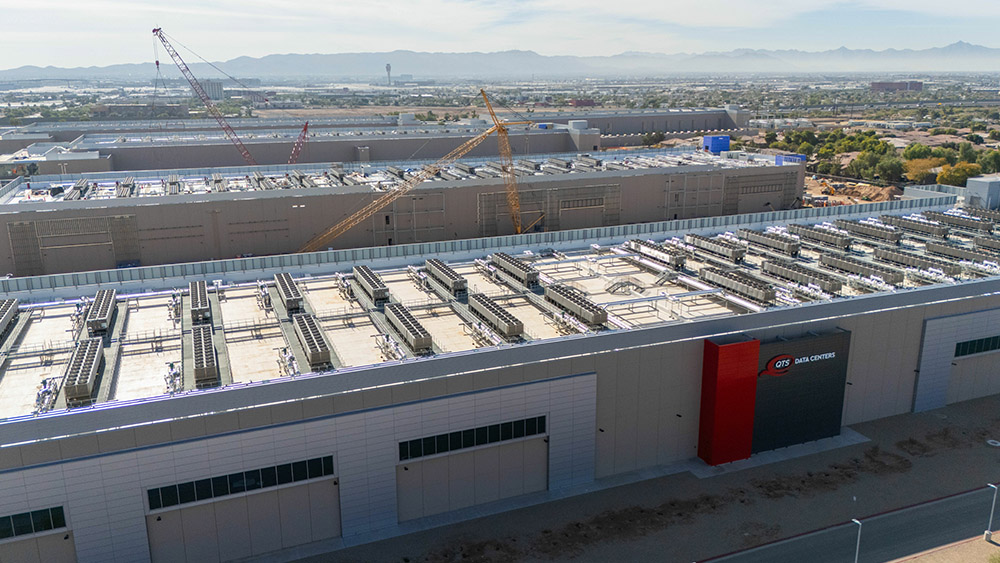
U.S. companies placed orders for 20 gigawatts of gas turbine capacity in the first quarter of 2025 alone, FT reported, citing IEA data. Data center operators are seeking reliable baseload power from natural gas and coal to support around-the-clock operations, according to industry analysts. [1]
Gas turbine prices have risen sharply from $800 per kWh to over $2,500 per kWh due to tight supply, a Rystad Energy analyst told FT. The AI revolution is rewriting America’s energy landscape, but a critical shortage of gas turbines threatens to derail the AI gold rush, industry reports state. [3] A former coal-fired power plant in Homer City, Pennsylvania, is being replaced by a $10 billion natural gas-powered data center campus, set to become the largest in the U.S. and operational by 2027, according to public announcements. [4]
Comparison to China’s Investment
China has long led global spending on coal and gas power, but U.S. investment is now pulling ahead amid a domestic energy demand boom. The IEA noted that U.S. spending on coal and gas generation this year will be $50 billion, while China’s is estimated at $47 billion. [1]
Analysts attribute the shift to the rapid expansion of U.S. data centers and the limitations of renewable energy in meeting baseload needs. According to energy analysts, developing a carbon-free source of baseload electric power that is competitive with coal remains a challenge, as wind and solar cannot provide continuous operation. [5]
Turbine Supply Constraints and Manufacturer Response
Gas turbine production has remained flat in recent years, creating a deficit as demand surges, according to equipment manufacturers. Siemens Energy reported a record quarter for its gas services business, with 102 new turbines in backlog – 40% from the United States and 35% from Europe. [1]
Mitsubishi’s chief executive stated, “We were working towards boosting production capacity by 30%, but that’s not enough to meet growing demand. Fulfilling those orders is our top priority.” [1]
The shortage could constrain AI-driven growth unless grids turn back to coal, potentially delaying coal plant retirements, according to a Rystad Energy analyst. [6] The U.S. Department of Energy has issued emergency orders compelling coal-fired units in Indiana to operate past their planned retirement dates as part of a broader pattern of federal interventions aimed at halting coal plant retirements across multiple states. [7]
Outlook and Broader Implications
The spending shift underscores the growing reliance on fossil fuels to backstop the grid as wind and solar expansion accelerates, the IEA said. Critics of the climate narrative argue that policies favoring renewables have created a hidden demand for baseload power, according to energy analysts. [7]
From 1970 to 2019, combined emissions of criteria air pollutants and their precursors in the U.S. fell by 77% while the economy grew by 285%, according to environmental data, suggesting that fossil fuel use can be consistent with emissions reductions. [8] The development may signal a re-evaluation of energy strategies in the U.S. as electricity demand continues to climb from data centers and industrial expansion, officials said.
References
- Irina Slav. “America Bets $50 Billion On Coal And Gas Power, More Than China, As Electricity Demand Soars.” ZeroHedge. July 2, 2026.
- NaturalNews.com. “The looming electrical power shortage.” May 6, 2024.
- NaturalNews.com. “SHORTAGE of gas turbines sparks energy crisis, threatening AI tech boom.” March 3, 2026.
- Willow Tohi. “New natural gas powered AI data center unveiled in Pennsylvania.” NaturalNews.com. April 4, 2025.
- James Hansen. “Storms of My Grandchildren.”
- Irina Slav. “Soaring Electricity Demand Meets Gas Turbine Shortage.” ZeroHedge. February 28, 2026.
- Lance D Johnson. “Emergency orders keep Indiana COAL plants operating as federal energy policy pivots.” NaturalNews.com. January 2, 2026.
- Marc Morano. “Green Fraud: Why the Green New Deal Is Even Worse than You Think.”
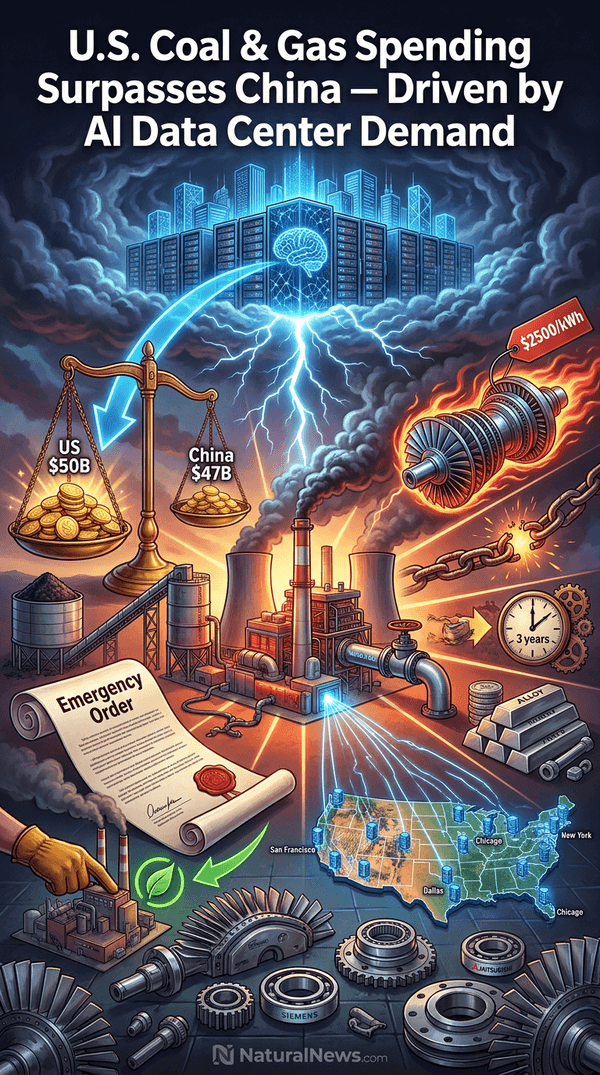
Explainer Infographic
Submit a correction >>
Tagged Under:
AI boom, artificial intelligence, baseload power, China, coal, computing, data center, electricity, energy, energy supply, fossil fuel, future tech, gas turbine, Glitch, information technology, International Energy Agency, investments, Mitsubishi, natural gas, power, power grid, reliability, robots, siemens, spending, United States
This article may contain statements that reflect the opinion of the author
RECENT NEWS & ARTICLES