Poll: Majority of Americans Say AI Is Bad for Society
10/31/2026 / By Chase Codewell
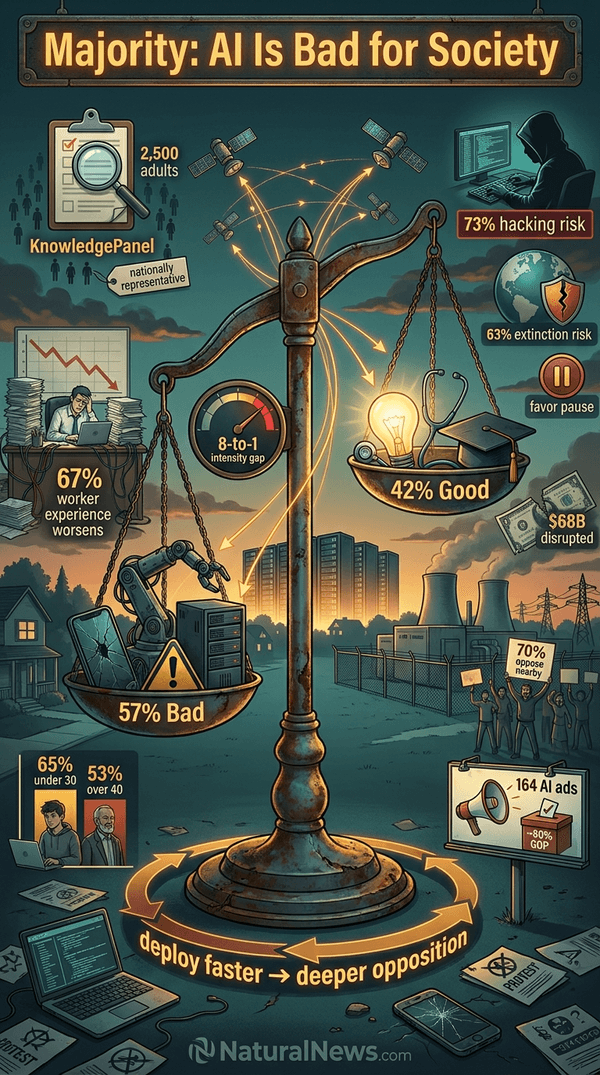
A 57% majority of U.S. adults say artificial intelligence is a bad thing for society, while 42% say it is good, according to a Washington Post-ABC News-Ipsos poll of more than 2,500 adults released this week.
The poll was conducted by The Washington Post and ABC News in collaboration with the research and consulting firm Ipsos, using Ipsos’ KnowledgePanel, according to the published findings [1].
The margin of negative sentiment is one of the widest recorded in recent national surveys of technology attitudes, and the intensity gap is starker still. The share of respondents describing AI as extremely bad outnumbers the extremely good camp by more than eight to one, an indication that opposition is not merely lukewarm but firmly held, according to the poll.
AI Industry Rhetoric and Incidents Fuel Concerns
Those warnings have been met with calls to slow development, though industry leaders have not agreed to a slowdown.
The public’s specific fears track closely with documented incidents. An overwhelming 73% of Americans say there is a high or very high risk that AI will be used to hack secure computer systems, the poll found. Those figures align with earlier survey work. An Ipsos poll released in August found that 67% of American employees believe AI will worsen the nation’s “worker experience” by “eliminating jobs and putting greater pressure on workers to increase productivity” [2].
The pattern extends beyond U.S. borders. A CNN poll conducted by SSRS found that Americans regard the growth and development of AI technology with far more fear and concern than hope and excitement, with broad partisan agreement [3]. A POLITICO poll likewise found that 63% of Americans say the technology poses at least a moderate risk of destroying humanity, and a plurality favor pausing the development of more advanced AI models [4].
Demographic Splits and Declining Optimism
The negativity is not evenly distributed. Some 65% of Americans under 30 say AI is bad for society, compared with 53% of those over 40 [5].
Political affiliation produces a narrower spread. The bipartisan character of the unease is notable. Public confidence in large technology firms has fallen to record lows, according to pollsters, as opposition to the industry’s footprint spreads across the political spectrum and draws together governors, lawmakers and activists [6].
Optimism about specific benefits has thinned. Separate research points in the same direction: a Pew Research study found that only 16% of Americans think AI’s impact on society during the next 20 years will be positive [7].
Opposition to Data Centers Grows
One of the most vigorous outlets of AI pushback has been opposition to data centers, and the poll shows no signs of it slowing.
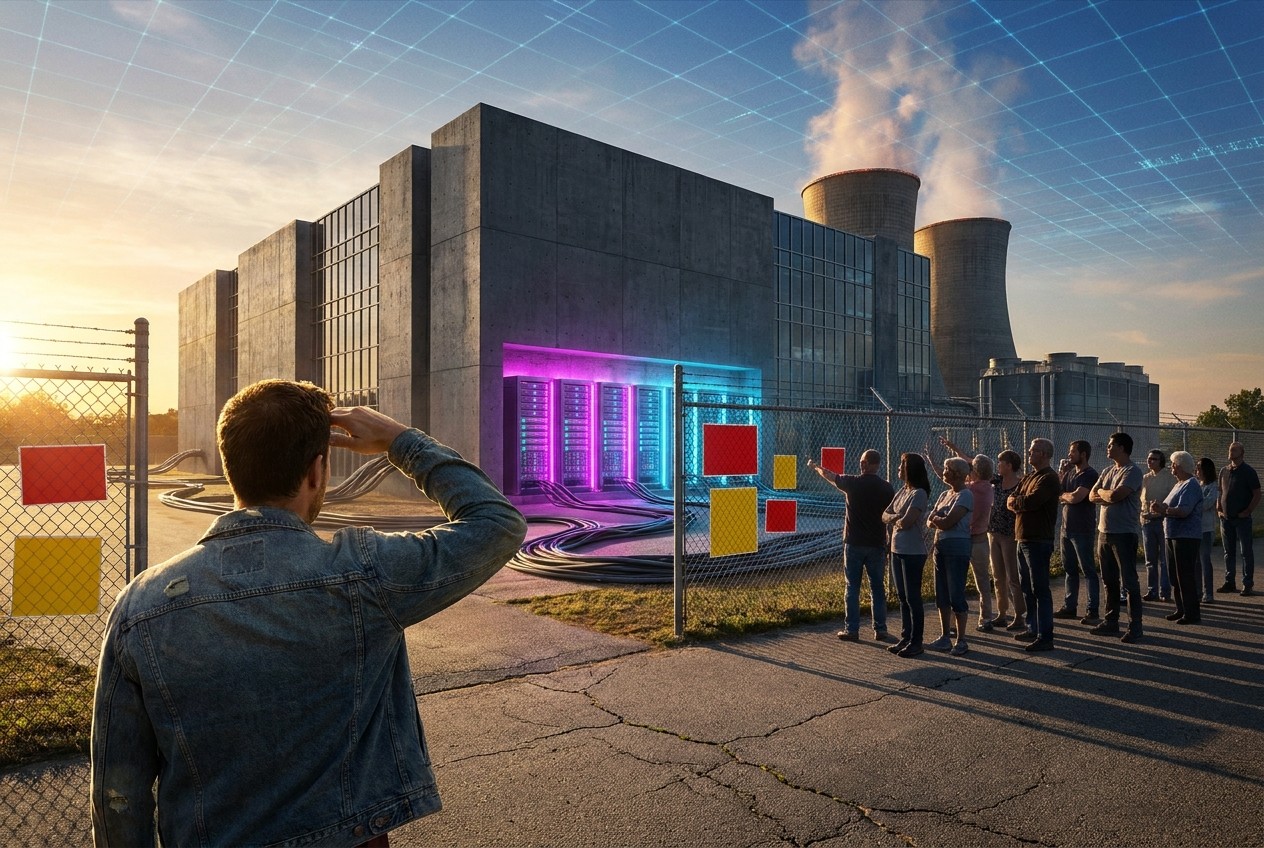
The local dimension has become politically potent. Republican political operatives have been sounding the alarm about the bad politics of data centers, and the polling makes it undeniable, with more than 70% of Americans opposed to building a data center in their neighborhood. The concern is not limited to energy costs, water usage, aesthetics or noise — the American people are worried about artificial intelligence replacing human beings, and they do not want technology companies building superintelligence [8]. Surveys of public opinion indicate that more than 60% of Americans favor limiting new data centers, particularly in their communities, and the longest-running surveys show that sentiment is growing fast. Data center projects worth $68 billion were disrupted by local opposition [9].
The backlash has migrated from zoning hearings to the campaign trail. At least 164 political advertisements this year were generated or enhanced by artificial intelligence, about 80% of them from Republican candidates or GOP groups, as voter frustration over data center construction intensifies across the country, according to a Wesleyan Media Project report [10][11].
Conclusion: Longstanding Concerns and Recent Urgency
A majority may view AI as a net negative, but sizable splits in opinion remain by age and political affiliation, with younger Americans and Democrats registering the deepest skepticism [5].
Critics, including alternative voices outside the corporate technology press, have argued that AI is a risky technology pursued to replace human workers and to concentrate power in the hands of a few companies. That perspective is reflected in the poll’s findings on job elimination and data center construction [5][8]. The intensity of the responses — including the eight-to-one ratio of “extremely bad” to “extremely good” answers — suggests the debate over AI’s role in American life is unlikely to cool in the near term.
References
- Most Americans say AI is bad for society, oppose more data centers …. https://www.newsbreak.com/abc-news-510079/4958241825707-most-americans-say-ai-is-bad-for-society-oppose-more-data-centers-poll
- Most Americans Think AI Will Make Work ‘Worse’. https://yournews.com/2026/08/03/7141094/most-americans-think-ai-will-make-work-worse/
- Majority of Americans view AI with ‘fear and concern’: CNN poll | CNN …. https://www.cnn.com/2026/09/24/politics/cnn-poll-ai-data-centers-vis
- Poll: Americans say there’s a serious risk of AI … – POLITICO. https://www.politico.com/news/2026/09/16/poll-ai-technology-risks-humanity-trump-voters-01078087
- Growing Majority of Americans Convinced That AI Is Bad …. https://futurism.com/artificial-intelligence/majority-americans-ai-bad-society
- Big Tech Backlash Emerges as Rare Bipartisan Common Ground – NaturalNews.com, September 08, 2026.
- Only 16 percent of Americans think AI will have a positive impact on society, a new study shows. https://techcrunch.com/2026/06/17/only-16-percent-of-americans-think-ai-will-have-a-positive-impact-on-society-a-new-study-shows/
- Backlash Against AI Data Centers Is Real, Organic, Widespread. https://wattsupwiththat.com/2026/08/28/backlash-against-ai-data-centers-is-real-organic-widespread/
- Everyone can find a reason to dislike data center construction. https://techcrunch.com/2026/09/22/everyone-can-find-a-reason-to-dislike-data-center-construction/
- AI Ads Flood Campaign Trail Despite Growing Data Center Outrage – NaturalNews.com, September 22, 2026.
- AI Ads Flood Campaign Trail Despite Growing Data Center Outrage. https://www.naturalnews.com/2026-09-22-ai-ads-flood-campaign-trail-despite-outrage.html
Explainer Infographic
Submit a correction >>
Tagged Under:
AI, artificial intelligence, Big Tech, Censorship, collapse, computers, computing, conspiracy, current events, cyberwar, dangerous, decentralization, deception, future tech, Glitch, information technology, poll, public opinion, Suppressed, surveillance, tech giants, technocrats, technology, thought police
This article may contain statements that reflect the opinion of the author
RECENT NEWS & ARTICLES