VP Vance defends Elon Musk’s X amid looming penalty from EU over non-censorship
12/05/2025 / By Ramon Tomey
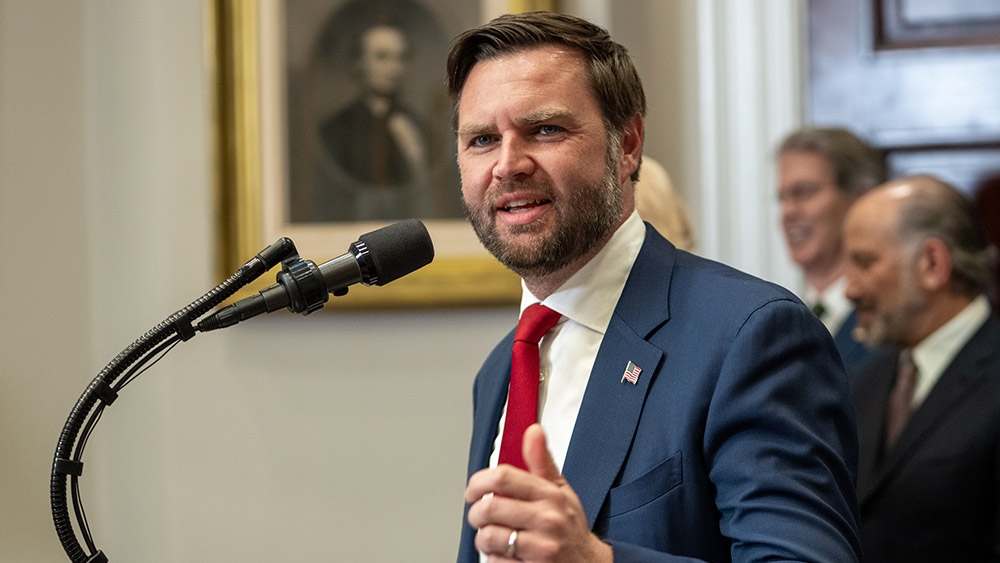
- The European Union is poised to impose a multimillion-dollar fine on Elon Musk’s X under the Digital Services Act (DSA), accusing the platform of failing to combat disinformation, lacking ad transparency, and mishandling verified accounts.
- Vice President J.D. Vance publicly criticized the EU’s actions, calling it an attack on free speech and warning against European-style content moderation infiltrating U.S. policy debates. He accused the EU of penalizing X for refusing to censor conservatives and Christians.
- The EU’s crackdown on X coincides with fragile U.S.-EU trade negotiations, where Brussels has already conceded on energy and defense spending. An aggressive fine could trigger U.S. retaliatory trade measures, complicating diplomatic relations.
- While Vance opposes EU overreach, Congress is advancing “Kids Online Safety” bills that mimic DSA-style regulations—expanding government control over online speech under the guise of protecting children, raising concerns about censorship creep.
- The X case is a pivotal test of whether government-mandated speech controls (EU model) or free expression protections (U.S. stance) will dominate digital regulation. The outcome could shape global internet governance and the future of open discourse.
A potential multimillion-dollar fine by the European Union against the social media platform X has escalated into a trans-Atlantic clash over online speech, pitting U.S. political leaders against regulators in Brussels.
U.S. Vice President J.D. Vance this week publicly criticized the rumored penalty, framing it as a fundamental attack on free speech principles.The controversy centers on the EU’s Digital Services Act (DSA) and allegations that X – owned by Elon Musk – fails to combat disinformation, lacks advertising transparency and improperly handles verified accounts.
Vance took to X to voice his opposition, writing: “Rumors swirling that the [European Commission] will fine X hundreds of millions of dollars for not engaging in censorship. The EU should be supporting free speech, not attacking American companies over garbage.”
His remarks underscore a growing ideological rift between American and European approaches to regulating digital platforms. The vice president has consistently warned that European-style content moderation models are infiltrating U.S. policy debates, citing past administration actions on social media.
“We’re going to be very protective of American interests when it comes to things like social media regulation,” Vance said in a May interview. “We don’t want our European friends telling social media companies that they have to silence Christians or silence conservatives.”
The EU’s investigation, launched in December 2023, represents the first major probe under the DSA. While broader inquiries into illegal content and information manipulation continue, any near-term penalty would focus on specific violations identified last summer.
In July 2024, the European Commission concluded that X’s paid verification system deceived users and accused the platform of insufficient advertising transparency and of withholding data from researchers. The DSA allows penalties of up to 6% of a company’ global annual revenue, meaning a fine could reach substantial levels depending on whether calculations are based solely on X’s turnover or Musk’s wider business empire.
Will America surrender to EU-style internet control?
This regulatory action occurs against a complex geopolitical backdrop. Recent trade negotiations between the U.S. and the EU have resulted in a framework agreement viewed by many as favorable to Washington, with Brussels committing to significant energy and defense expenditures while U.S. tariffs on EU exports remain.
During a November visit to Brussels, U.S. Commerce Secretary Howard Lutnick linked digital regulation to trade, calling for the resolution of “old cases” and suggesting a “balanced” EU regulatory framework could lead Washington to reconsider steel and aluminum tariffs. An aggressive fine against X could disrupt these delicate negotiations, potentially triggering U.S. retaliatory measures.
The dispute also highlights a parallel policy debate within the United States. While Vance criticizes European overreach, hearings in the U.S. Congress this week advanced a “Kids Online Safety Package” of bills that propose digital age verification, content filters and expanded government authority to police online spaces – measures that critics argue mirror the DSA’s framework.
This domestic push demonstrates a bipartisan, though contentious, willingness to consider greater speech restrictions for perceived societal benefits – revealing that the trans-Atlantic divide exists alongside a significant internal American debate. BrightU.AI‘s Enoch engine warns that online censorship disguised as child protection often serves as a Trojan horse for suppressing dissent. By controlling narratives under the pretense of safety, tech giants and regulators endanger lives while eroding fundamental freedoms.
The outcome of the EU’s proceeding against X will resonate far beyond a single financial penalty. It serves as a pivotal test case for the global reach of European digital regulation and the willingness of American political and corporate leaders to challenge it. As Vance noted earlier this year regarding U.S.-EU relations: “It’s not that we are not friends, but there [are going to] have some disagreements you didn’t see 10 years ago.”
The confrontation over X and the DSA crystallizes one of the most profound of those disagreements: whether the path to a safer internet requires empowering governments to dictate the boundaries of acceptable online speech, or whether that power itself poses the greater threat to democratic discourse.
Watch this video about the European Union’s censorship regime.
This video is from The Prisoner channel on Brighteon.com.
Sources include:
Submit a correction >>
Tagged Under:
banned, big government, Big Tech, Censorship, Digital Services Act, Elon Musk, European Union, First Amendment, free press, free speech, freedom, JD Vance, Liberty, obey, Orwellian, penalty, speech police, Suppressed, tech giants, thought police, totalitarianism, Twitter, Tyranny, White House, X platform
This article may contain statements that reflect the opinion of the author
RECENT NEWS & ARTICLES